Key Takeaways:
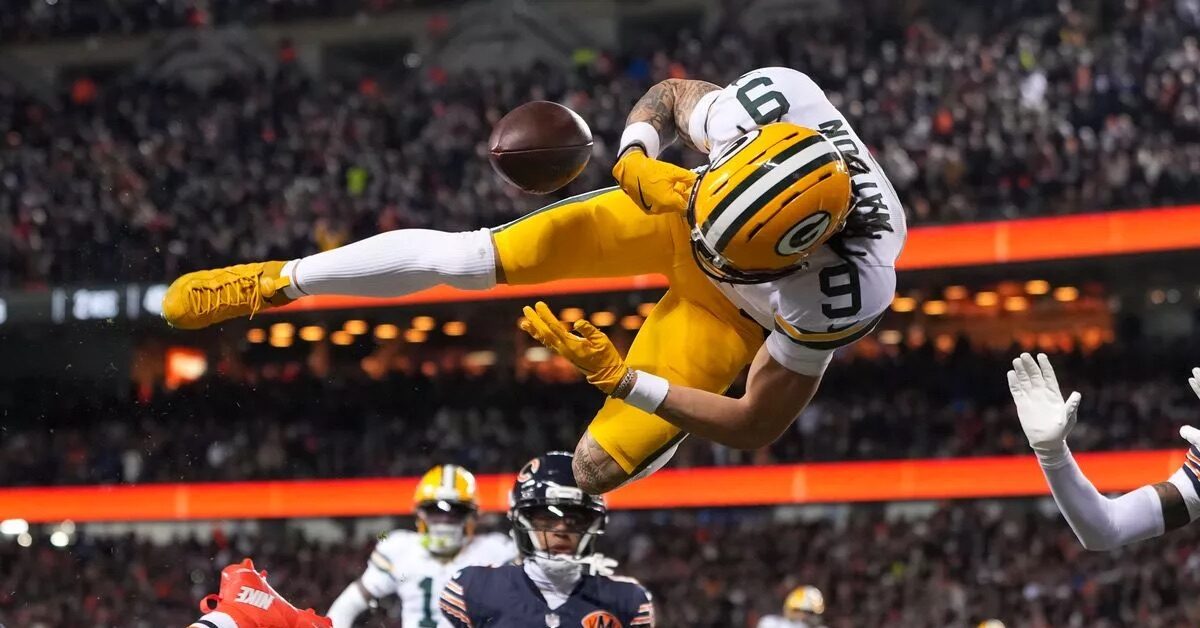
- Historic comeback: Bears beat Packers 31-27 after trailing 21-3 at halftime and 18 entering the fourth, becoming the fourth NFL team to win a playoff game when down 15+ in the final quarter.
- Rookie rise: Caleb Williams went 24-of-48 for 361 yards, 2 TDs and 2 INTs, hit DJ Moore for the 25-yard winner with under two minutes left, and logged his seventh game-winning drive of the season (tied for NFL most).
- Packers collapse: Green Bay scored TDs on its first three drives for a 21-3 lead, then punted four straight times in the second half and finished the year on a five-game skid.
- Rams survive: Los Angeles edged Carolina 34-31 on the road. Matthew Stafford threw for 304 yards and 3 TDs, including a 27.3% probability strike (Next Gen Stats) on the go-ahead march.
- Puka Nacua starred with 10 catches for 111 yards and a TD, offsetting a tough drop before halftime that likely cost L.A. points.
- Bryce Young shined in defeat: first playoff start, late scramble TD and a 19.7% probability go-ahead dime to Jalen Coker; Rams’ pressure on the final drive forced four straight incompletions.
Wild-card weekend opened on Saturday, Jan. 10, with two NFC games that delivered every shade of drama. The Los Angeles Rams went to Charlotte and outlasted the Carolina Panthers, 34-31. Then, in prime time, the Chicago Bears stormed back from an 18-point fourth-quarter hole to stun the Green Bay Packers, 31-27. It was the perfect one-two punch to launch the playoffs: a road shootout, followed by a historic home rally that will echo in Chicago for years.
This is a day to talk winners and losers — and the thin margins that separate both in January.
Rams vs. Panthers: Stafford’s nerve, Nacua’s edge, Young’s growth
In a 34-31 thriller, Matthew Stafford once again looked built for this stage. As NFL.com noted, “Stafford finished 24 of 42 for 304 yards, with three TDs and an interception.” One evaluation even called his showing “MVP stuff.” That reads right when you consider the drive that won it. According to Next Gen Stats, his key completion to Demarcus Robinson had just a 27.3% chance of being caught — the second-most improbable throw of the game.
His top target was the league’s volume king, Puka Nacua. The second-year receiver was, in NFL.com’s words, “nearly unstoppable” on a 10-catch, 111-yard, one-touchdown day. He did have a brief lapse — a drop on a perfect Stafford ball before halftime that likely took points off the board — but he more than made up for it as the Rams, the No. 5 seed, kept pressing on the road.
Across the field, Bryce Young turned his first playoff start into a statement. As the recap put it, Young “delivered over and over.” Carolina asked him to push the ball downfield more, and he answered with a scramble touchdown and a gorgeous, over-the-shoulder go-ahead throw to Jalen Coker with 2:39 to play. Next Gen Stats gave that pass a 19.7% completion probability — the toughest connection of the game.
Young was sacked just twice and mostly kept clean, which helped the Panthers’ underdog shot. But the Rams found late heat. On Carolina’s final chance, pressure forced multiple scrambles and four straight incompletions, draining time and ending the upset bid.
- Winners: Stafford’s toughness and touch; Nacua’s relentless route-running; Carolina’s belief in Young’s arm.
- Losers: Situational execution before halftime (that drop loomed), and Carolina’s final-drive protection under the brightest lights.
"Bryce erased doubts this season — now Carolina needs to build a closing plan around him."
Bears vs. Packers: Caleb Williams writes a new chapter
Chicago’s 31-27 win over Green Bay will be remembered for the swing between halves as much as the score. The Packers blistered the Bears early, scoring touchdowns on their first three possessions and taking a 21-3 halftime lead. Chicago’s man coverage was punished in the red zone, a sharp turn from recent weeks when, as ESPN noted, Green Bay went 0-for-5 in Week 16 and Detroit 1-for-4 in Week 18.
Then the game flipped. The Bears’ defense adjusted and forced four straight punts in the second half. That set the stage for Caleb Williams, who has built an identity around late-game poise. He finished 24-of-48 for 361 yards, two touchdowns and two interceptions, including a 25-yard strike to DJ Moore for the go-ahead score with under two minutes left. As ESPN wrote, “It was enough to capture the lead with 1:48 to play when Caleb Williams connected with DJ Moore for a 25-yard touchdown.”
The comeback was not just clutch — it was historic. “The Bears are the fourth team in NFL history to win a playoff game after trailing by 15-plus entering the fourth quarter,” per ESPN. Williams authored 166 second-half passing yards on balls thrown 10+ yards downfield — the most he’s posted in any half — and now owns seven game-winning drives in the fourth quarter or overtime this season. That ties Denver rookie Bo Nix for the NFL lead and marks the most in a season by a Bears quarterback since the 1970 merger.
The result also adds a line to the franchise ledger: Ben Johnson became the first coach in Bears history to win a playoff game in his first season with the team. For Green Bay, it’s a bitter end — a five-game losing streak to close the year and a blown 21-3 cushion on the league’s biggest stage.
- Winners: Williams’ deep-ball confidence and late command; DJ Moore’s big-play timing; Chicago’s second-half defense; Johnson’s calm on the headset.
- Losers: Green Bay’s second-half offense, which lost its rhythm; the Packers’ situational defense when it mattered most.
"Rookie to closer: Williams didn’t flinch, he finished."
Who moved the needle most on Saturday?
Matthew Stafford and Puka Nacua carried their regular-season chemistry into January. Stafford’s late-game accuracy in tight windows, backed by that 27.3% probability completion, is the very definition of playoff-grade quarterbacking. Nacua’s volume and toughness kept the Rams on schedule in a noisy road spot, even after a costly first-half drop.
Bryce Young was a winner in a loss. He spent 2025, in NFL.com’s words, “erasing doubt that he is the franchise’s future,” and on Saturday he underscored it. The downfield aggression and timing to Coker, graded at just a 19.7% chance to be completed, signals a young quarterback who is seeing the game faster and trusting his touch.
Caleb Williams was the main character of the night. The Bears didn’t just rally; they did it because their rookie stayed aggressive, piled up deep yards, and owned the two-minute drill. His connection with DJ Moore has become Chicago’s late-game compass.
"Packers didn’t just lose the lead — they lost their blueprint after halftime."
The bigger picture
For the Rams, surviving as a road 5-seed against an inspired Panthers group keeps their veteran core on track for another January run. Their stars delivered, and their pass rush showed up when it had to on the final series.
For Chicago, this was more than a win — it was confirmation. The Bears’ identity that formed during the season, with close finishes and late drives, proved portable to the playoffs. The defense’s second-half reset matched the quarterback’s nerve. And with Ben Johnson making history in Year 1, the organization has a clear direction.
Green Bay leaves with questions. A brilliant start turned into a long, quiet second half, and a once-promising season ended on a five-game slide. The fix will start with re-finding rhythm, protection, and red-zone answers against teams that change the picture after halftime.
Final word
Saturday gave us the full wild-card experience: a classic road win driven by star power, and a comeback that felt impossible until it wasn’t. The Rams advance because their top duo played to form when it counted. The Bears advance because their rookie quarterback plays older than his years. January is about finishing — and on Saturday, Chicago and Los Angeles finished stronger than their opponents.