Tag: USA

  • Messi’s 70-Foot Statue to Light Up Kolkata

    Messi’s 70-Foot Statue to Light Up Kolkata

    Key Takeaways(TL;DR):

    • Lionel Messi will virtually unveil a record 70-foot statue of himself in Kolkata’s Lake Town on December 13, 2025.
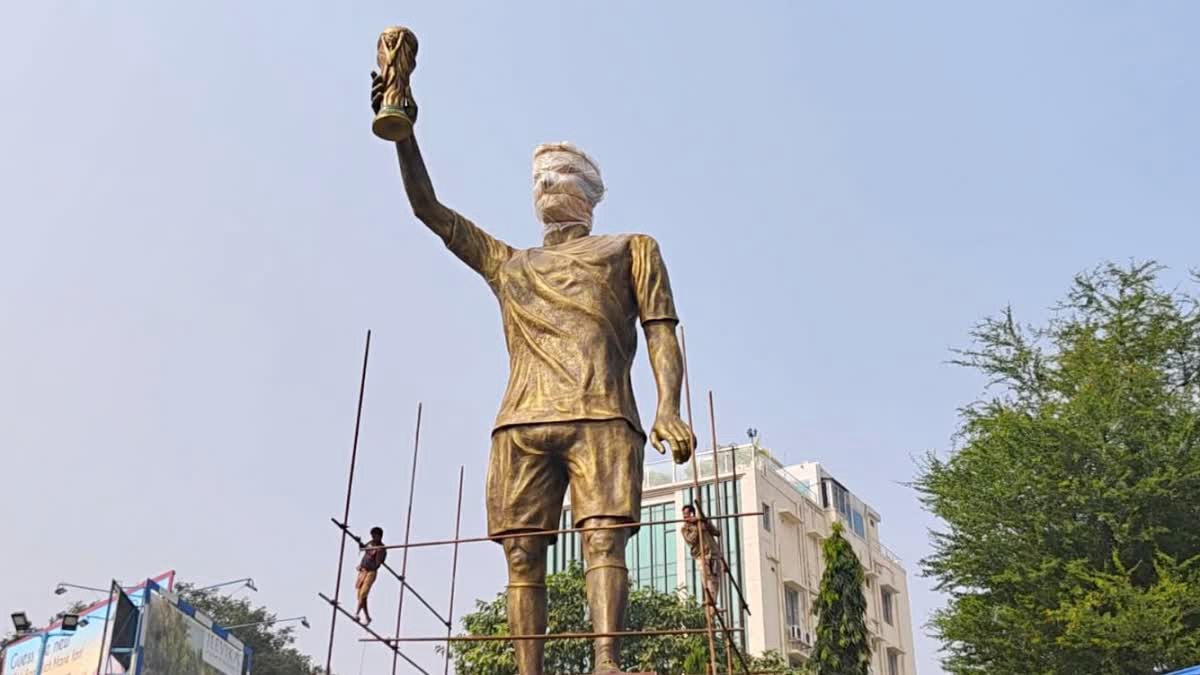
    • The statue, showing Messi lifting the FIFA World Cup trophy, was built in about a month by a 45-member team led by artist Monti Paul.
    • The unveiling is part of Messi’s three-day GOAT India Tour 2025, covering Kolkata, Hyderabad, Mumbai and New Delhi.
    • Due to security and crowd concerns, Messi will inaugurate the statue virtually, but the structure has already become a local landmark.
    • The tour includes meetings with Prime Minister Narendra Modi, state leaders, a celebrity football match, music performances, and charity events.
    • Kolkata’s new Messi statue joins the city’s long football tradition, adding to past tributes to icons like Diego Maradona.

    In December 2025, Kolkata will do something no other city in the world has done: raise Lionel Messi, quite literally, above its skyline.

    On December 13, a towering 70-foot statue of Messi, World Cup trophy in hand, will be unveiled in Lake Town, South Dum Dum. It will not only be the biggest statue of the Argentine legend anywhere on the planet, but also a bold new symbol of how deeply football runs through the heart of this Indian city.

    The twist? Messi will open his own statue from thousands of kilometres away. The inauguration will be done virtually, as part of his three-day “GOAT India Tour 2025” that has already sent a wave of excitement through Indian football fans.

    Why Kolkata Is Building a 70-Foot Lionel Messi

    Kolkata is not a random choice. The city has a long, proud love story with football. Streets here stop for derbies, kids grow up arguing about Brazil vs Argentina, and murals of Diego Maradona and Lionel Messi share walls with Bollywood stars and political icons.

    Now, the Lake Town area is adding a new chapter to that story with a Messi statue that reaches nearly 70 feet from the top to the base. The figure itself is around 50 feet, standing on a plinth that lifts it into the sky. The statue shows Messi frozen in the moment that defined his career and moved millions around the world: holding the FIFA World Cup trophy.

    This is not just a tribute to a player. It is a statement from a football city that sees itself in the global game and wants to be seen in return.

    West Bengal minister and Sree Bhumi Sporting Club president Sujit Bose, the key figure behind the project, put it simply:

    “This is a very big statue, 70 foot in height. There is no other statue of Messi this big in the world…. Messi is coming to Kolkata, and there are a lot of fans of Messi.”

    "Only in Kolkata do you build a 70-foot Messi and still say it’s not big enough for our love."

    Inside the Race to Build the World’s Biggest Messi Statue

    Behind the giant figure is a story of speed, pressure and teamwork. The statue was created by artist Monti Paul and a dedicated crew of about 45 people. Depending on the source, they finished it in just 27 to 40 days – a stunning pace for such a huge structure.

    Made mainly of iron, with some reports also calling it an iron and fiberglass structure, the statue is designed to be strong enough to deal with local weather while still capturing the lightness and joy of Messi’s World Cup moment.

    Paul described it as a “50-foot statue (70-foot including plinth)”, calling attention to the rapid build and the coordination needed to bring it to life in just about a month. This was not a slow, quiet art project. It was a high-speed mission with clear goals and intense attention from the public.

    Bose underlined the effort:

    “We built this statue in 40 days. Monti Paul made it ready. People were saying that we have a statue of Maradona, so why won’t there be one of Messi.”

    That line matters. Kolkata already has a strong emotional bond with Diego Maradona, who visited the city and has a statue of his own. For many fans, Messi is the natural next chapter in that story: the heir to Maradona, the boy from Rosario who grew into Argentina’s modern-day football god.

    The GOAT India Tour 2025: More Than Just a Statue

    The statue is just one piece of a bigger picture. Messi’s visit to India, named the “GOAT India Tour 2025,” will run from December 13 to 15 and cover four major cities: Kolkata, Hyderabad, Mumbai and New Delhi.

    This will be Messi’s second trip to India. His first came back in 2011, when he was still a rising superstar, not yet crowned as a World Cup-winning captain. A lot has changed since then – for him and for Indian football fans, who have only grown louder and more online in their support.

    Across these three days, the tour is expected to include:

    • Meetings with Indian Prime Minister Narendra Modi
    • Interactions with key state chief ministers
    • A celebrity football match featuring well-known faces
    • A charitable fashion show and memorabilia auction
    • Musical performances and entertainment events

    It is part football, part culture, part diplomacy and part business. Messi is not just a player now; he is a global brand, and India is one of the biggest, youngest fan markets in the world.

    "If Messi plays even one friendly here, that day becomes our World Cup final."

    Why the Unveiling Will Be Virtual

    Many fans would have loved to see Messi stand under his own statue in Lake Town and pull away the curtain himself. But the organisers, along with local authorities, have chosen a virtual inauguration instead.

    The reason is simple and blunt: security and law-and-order concerns.

    Kolkata does not do small crowds when it comes to football icons. The excitement around the statue has already turned the site into a local attraction even before the official unveiling. People stop, stare, take pictures and share them all over social media. Now imagine what would happen if Messi himself stood there in person.

    To avoid chaos and keep things safe, the plan is for Messi to join the unveiling digitally, likely from another stop on his India tour. Bose made it clear:

    “Messi will like this statue. Inauguration will be on the 13th virtually from Kolkata.”

    The decision may disappoint some, but it also underlines just how huge Messi’s pull is in India. When a player is so loved that authorities worry about handling the crowds, that is a sign of rare global reach.

    The View from the Streets: What Local Fans Are Saying

    On the ground in Kolkata, the feeling is simple and pure: joy that Messi is coming and pride that the city will host the biggest statue of him in the world.

    One local football fan summed it up with emotion:

    “Messi is coming here, and we will be able to see him. This is great for us. We are delighted about the statue that has been made here. I have no words to express about him (Lionel Messi).”

    For many in the city, Messi’s visit and the statue are not just about a celebrity drop-in. They are about being seen and respected as part of football’s global family. Kolkata has already welcomed stars like Maradona, Emiliano Martinez and Ronaldinho in recent years. Messi’s arrival feels like the next big step.

    Another fan explained the feeling of waiting to see Messi play, even in a friendly setting:

    “It feels so great to see Messi play… We are awaiting his arrival. We are very excited.”

    "Statues fade, but for our kids this will be proof: yes, Messi really came here."

    Tickets, Access and the Price of Seeing a Legend

    Messi may be everywhere on TV and online, but seeing him in person still carries a price. For the GOAT India Tour 2025, tickets for public appearances are set around 4,500 Indian Rupees (about 42 Euros), with higher prices in Mumbai.

    These tickets open doors to events like the celebrity match, fashion show and musical evenings tied to the tour. For many families, it will be a big decision – but for die-hard fans, the chance to see Messi live, even for a short time, could be worth every rupee.

    The tour also aims to do more than just sell tickets. With a charity fashion show and memorabilia auction on the schedule, there is a clear effort to turn Messi’s star power into funds for good causes, even as it deepens his brand and presence in India.

    Timing, Legacy and the Road to World Cup 2026

    The timing of this statue and tour is not random. With the FIFA World Cup 2026 approaching, global attention on top players and football markets is already growing. Messi may be in the later years of his playing career, but his influence off the pitch is only getting stronger.

    For India, which dreams of a bigger role in world football, a high-profile visit like this sends a message: big names see value here, not only in commercial terms, but also in culture and support.

    For Kolkata, the statue will stand long after Messi has flown out. It will be a new meeting point, a selfie hotspot, a landmark kids use as a direction marker when they tell friends where to meet. It joins a chain of tributes that link Maradona to Messi, Argentina to India, and one football-mad city to the rest of the world.

    What This 70-Foot Messi Really Means

    When Sujit Bose says, “People were saying that we have a statue of Maradona, so why won’t there be one of Messi,” he is doing more than answering a question. He is explaining Kolkata’s football soul.

    This is a city that has always picked its heroes from far away and made them feel like family. A 70-foot statue of Lionel Messi lifting the World Cup is not about worshipping a distant star. It is about telling every young player on every park ground that the game they love connects them to the biggest stages in the world.

    In the end, when Messi appears on screen on December 13 to virtually unveil his iron-and-fiberglass double in Lake Town, Kolkata will not be watching alone. Fans from across India – and likely far beyond – will be paying attention.

    They will see more than a giant statue. They will see proof that football, and one small man from Rosario, can still tower over cities, countries and borders – and bring them all together under one shared sky.

  • FIFA chief Infantino faces ethics storm over Trump peace prize

    FIFA chief Infantino faces ethics storm over Trump peace prize

    Key Takeaways(TL;DR):

    • FairSquare has filed an official complaint to FIFA’s Ethics Committee, accusing president Gianni Infantino of breaking FIFA’s rule of political neutrality.
    • The complaint focuses on Infantino’s public support of Donald Trump and the decision to give Trump the inaugural FIFA Peace Prize.
    • FairSquare says Infantino may have abused his power if he created and handed out the FIFA Peace Prize without proper approval.
    • FIFA’s ethics rules demand neutrality in political matters, and any breach can lead to a two-year ban from football activities.
    • The Trump peace prize has been slammed as “phony” and “beyond parody,” fueling wider anger over FIFA’s governance and credibility.
    • The case could become a major test of whether FIFA is serious about its own ethics code and political neutrality.

    The head of world football is now at the centre of a storm of his own making. A new complaint to FIFA’s powerful Ethics Committee accuses president Gianni Infantino of breaking one of the organisation’s most basic rules: stay out of politics.

    At the heart of the case is a decision that shocked many around the game – the creation of a FIFA Peace Prize and its first winner: former U.S. president Donald Trump. What was sold as a moment of celebration has instead triggered questions about power, neutrality, and whether FIFA’s own boss believes the rules apply to him.

    Who is challenging Infantino – and why now?

    The complaint was filed by FairSquare, a non-profit group that focuses on global labour migration rights, political repression, and sport. This is not a group shouting from the sidelines. FairSquare has a track record of taking on football’s most powerful bodies, including past challenges over Saudi Arabia’s selection as 2034 World Cup host and the role of oil giant Aramco as a FIFA sponsor.

    This time, they are going straight for the top. Their complaint, reported by outlets including SportsBusinessJournal, asks FIFA’s Ethics Committee to open a formal investigation into Infantino over what they describe as repeated breaches of the duty of political neutrality written into FIFA’s Code of Ethics.

    According to those reports, FairSquare’s submission sets out four alleged breaches, all linked to what they call Infantino’s “public championing” of Donald Trump. The details of each breach are not all public, but the pattern – Infantino using his status to praise and promote a highly divisive political figure – is clear enough for the group to say the line has been crossed.

    The complaint also goes a step further, asking how the FIFA Peace Prize came into existence in the first place, and whether the way it was introduced followed FIFA’s own procedural rules.

    In their own words, FairSquare warns: “If Mr. Infantino acted unilaterally and without any statutory authority, this should be considered an egregious abuse of power.”

    “How can fans trust FIFA’s rules if the president seems free to ignore them?”

    FIFA’s political neutrality rule – and what’s at stake

    For years, FIFA has tried to tell governments and politicians to keep their hands off football. National federations can be punished if their governments interfere. Teams can be sanctioned if political slogans or campaigns spill onto the pitch.

    That stance is written into FIFA’s ethics rules. Article 15 of the FIFA Code of Ethics requires strict political neutrality from key officials, including the president. As USA TODAY’s Scooby Axson has noted, those ethics bylaws “require neutrality in all political matters,” and violations can carry a two-year ban from the sport.

    So this is not a soft warning. If the Ethics Committee finds that Infantino broke the neutrality rule in a serious way, he could, in theory, face a suspension that would remove him from all football activity for up to two years. For a sitting FIFA president, that would be a seismic blow.

    We are not at that point yet. So far, there is a complaint. FIFA’s communications team has been informed. The next move belongs to the Ethics Committee, which has the power either to quietly park the case, or to open a full, public investigation that would put Infantino under intense pressure.

    The Trump peace prize that no one saw coming

    The spark for this battle was a move that even some seasoned FIFA watchers struggled to take seriously: a newly created FIFA Peace Prize handed to Donald Trump.

    Trump, of course, has long wanted a different peace prize – the Nobel – and never got it. Instead, he received this untested honour from world football’s governing body. It came with glowing praise from Infantino at a time when Trump’s political record and behaviour remained deeply controversial in the U.S. and abroad.

    The reaction was brutal. French paper Le Monde, through writer Jerome Latta, called it “a moment so far beyond parody or satire that it was impossible to laugh.” Salon.com described how Infantino “showered Trump with meaningless praise,” labelling the prize “phony” and pointing to the sharp contrast between Trump’s actions and the idea of a peace award.

    According to reports cited by SportsBusinessJournal, FairSquare’s complaint puts this episode at the centre of its case. It asks not just whether it was wise, but whether it was even legal inside FIFA’s own system to create and award such a prize, and to give it to a sitting or recent political leader known for divisive policies.

    “A FIFA Peace Prize for Trump feels like a bad joke that somehow became official.”

    From World Cup draw spectacle to ethics headache

    The Trump peace prize did not happen in a vacuum. Infantino and Trump had already stood side by side in high-profile settings, including around the 2026 FIFA World Cup, which will be hosted by the United States, Canada and Mexico.

    During the World Cup draw in Washington D.C., the pair appeared together in what some observers labelled a “spectacle for their own glorification.” It was another clear blending of football’s global stage with political theatre, with both men benefiting from the cameras and the symbolism.

    On one level, FIFA presidents have always had to deal with heads of state. They need political support for tournaments, infrastructure and security. But there is a line between necessary diplomacy and open political endorsement. FairSquare’s complaint argues that Infantino has stepped over that line by repeatedly championing one politician in particular.

    And that is where the neutrality rule becomes more than a vague principle. If FIFA tells players and federations to stay out of politics, but its president is seen to be boosting one of the world’s most divisive political figures, the organisation’s credibility takes a hit.

    Why FairSquare’s challenge matters for FIFA’s future

    FairSquare is not the first group to question FIFA’s governance, but it has built a reputation for serious, evidence-based challenges. It has previously raised alarms about:

    • The selection of Saudi Arabia as host for the 2034 World Cup.
    • The influence of Saudi oil company Aramco as a FIFA sponsor.
    • Gaps in FIFA’s own governance and compliance processes.

    This latest complaint fits that pattern. It is not just about one prize or one ceremony. It is about whether FIFA follows its own rulebook, especially at the very top.

    The question is simple but powerful: if the president can push through a new award, use it to celebrate a political ally, and do so without clear approval from FIFA’s bodies, what does that say about checks and balances inside the organisation?

    FairSquare’s warning that this would be an “egregious abuse of power” if done unilaterally is pointed. It is saying to FIFA’s Ethics Committee: if you care about the code, this is the moment to prove it.

    “Either FIFA enforces neutrality on everyone, or the word ‘ethics’ is just window dressing.”

    Can FIFA’s Ethics Committee really act against its own president?

    On paper, yes. The Ethics Committee has the power to investigate and sanction any football official, including the president. In the past, it has banned high-profile figures for corruption and other misconduct.

    In practice, the politics are much harder. Investigating a sitting president over alleged political bias and a controversial award to a former U.S. president would be a huge step. It would immediately become global news and would test how independent FIFA’s watchdogs really are.

    Still, the rules are clear. Ethics officials must look at whether:

    • Infantino’s public support of Trump, including the peace prize, broke the duty of neutrality.
    • The FIFA Peace Prize was created and awarded in line with FIFA’s statutes and procedures.
    • Any abuse of office or overreach took place in the process.

    FIFA has been made aware of the complaint. Now, the football world waits to see whether it will stay silent or allow an open examination of the president’s actions.

    Beyond one prize: a test of trust in world football

    The anger over Trump’s FIFA Peace Prize goes beyond personal dislike or party politics. Many critics see it as another symbol of how far FIFA can drift from the values it claims to stand for.

    When Le Monde calls the moment “beyond parody,” and Salon labels the award “phony,” they are not just mocking Trump. They are mocking FIFA for trying to dress up a political moment as a celebration of peace, at a time when the game is already battling questions over money, human rights, and fairness.

    For fans, the issue is simple. They want to believe that when FIFA talks about ethics and neutrality, it means it. If the body that bans players for slogans on a shirt allows its own president to publicly favour a controversial leader without consequence, that belief crumbles.

    The FairSquare complaint has turned the Trump peace prize from an awkward headline into a serious test case. If the Ethics Committee investigates and acts, it could signal a new era of accountability at the top of football. If it does nothing, it may confirm the suspicion that in Zurich’s glass towers, some people are still too powerful to touch.

    Either way, the damage to FIFA’s image is already done. A prize that was meant to shout “peace” has instead whispered a very different message: in world football’s most powerful office, the lines between sport and politics are more blurred than ever.