
Key Takeaways:
- Aryna Sabalenka beat Karolína Muchová 6-3, 6-4 to reach the Brisbane International final.
- She closed the match on her fourth match point after three chances slipped away late.
- The semifinal was played at Pat Rafter Arena in Brisbane, Australia.
- Sabalenka advances to Sunday’s Brisbane final to face Jessica Pegula or Marta Kostyuk.
- She saved all four break points and tallied 32 winners, entering her 13th WTA 500 final.
- Brisbane is a tune-up event before the Australian Open begins Jan. 18.
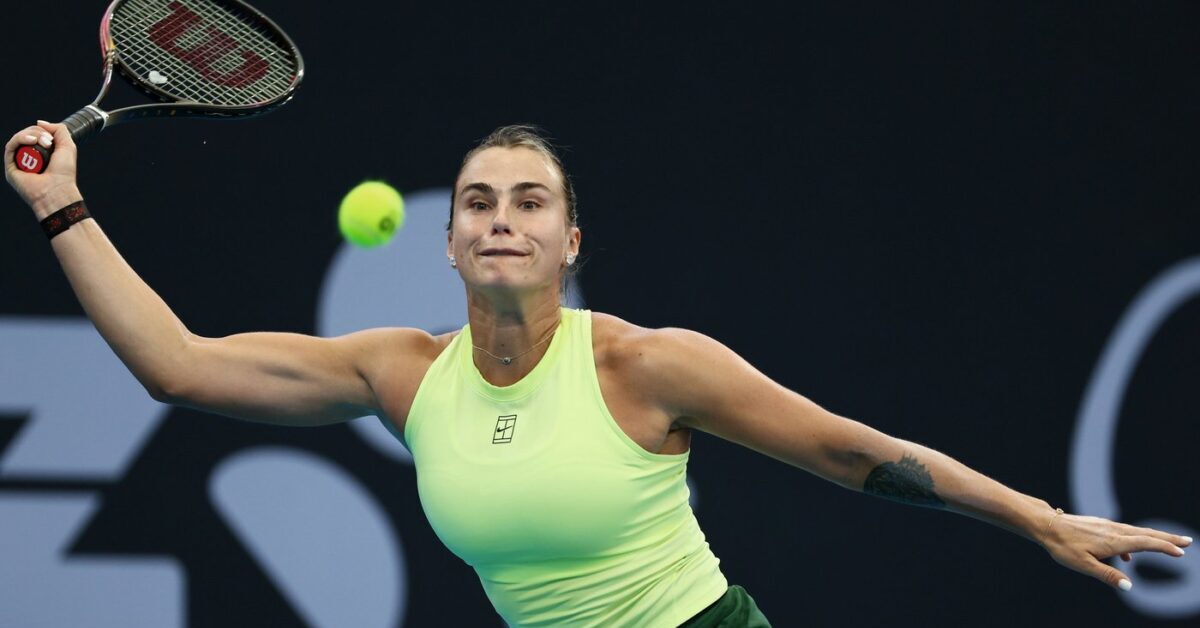
World No. 1 and defending champion Aryna Sabalenka is back in the Brisbane International final. The top seed handled Karolína Muchová 6-3, 6-4 in Saturday’s semifinal at Pat Rafter Arena, sealing the win on her fourth match point to book a spot in Sunday’s title match. She will face the winner of the later semifinal between No. 4 seed Jessica Pegula and Marta Kostyuk.
This event is more than a trophy chase. Brisbane is a springboard for the Australian Open, which starts on January 18. With the new season buzzing, Sabalenka picked a perfect time to show clean ball striking, calm under pressure, and the kind of baseline power that makes her the favorite wherever she plays.
Statement win at Pat Rafter Arena
Sabalenka controlled the match from the start. She set the tone with heavy first strikes, took time away from Muchová, and guarded her serve when the Czech player tested her late in the second set. Three match points came and went during a flurry of resistance, but Sabalenka did not blink. She finished the job when a Muchová backhand drifted long.
The numbers match the eye test. Reports from courtside noted Sabalenka hit 32 winners and saved all four break points she faced. That blend of pace and poise gave her a straight-sets win that looked steady and professional. It is the type of match you expect from a world No. 1 in week one of the season: firm, focused, and free of panic.
Why this 6-3, 6-4 was bigger than the score
On paper, a straight-sets win suggests a stress-free afternoon. In reality, it showed something more important: control in the moments that decide big matches. When Muchová raised her level late, Sabalenka closed the door with first serves and aggressive, measured replies. No rush, no wild swings—just a smart finish.
Context matters. This is Sabalenka’s third straight Brisbane final and the 13th WTA 500-level final of her career. Players don’t keep returning to finals by accident. They do it by repeating good patterns—taking care of service games, staying stingy on break points, and trusting their weapons when the tension rises.
“This is the world No. 1 doing world No. 1 things—clinical when it counts.”
From Keys rematch to Muchová: a sharp path through Brisbane
If Saturday was about control, Friday was about force. In the quarterfinals, Sabalenka cracked Madison Keys’ serve in five straight service games to win 6-3, 6-3. That match carried extra meaning. It was a rematch of last year’s Australian Open final, where Keys beat Sabalenka to win her first Grand Slam singles title.
Sabalenka didn’t dwell on that result; she simply outplayed Keys this time. That kind of quick reset speaks to a champion’s memory—short on bad losses, long on lessons learned. Beating Keys cleanly and then subduing Muchová shows a two-speed gear: power when needed, patience when required.
“Five straight breaks of serve one day, ice-cold closing the next—Sabalenka’s toolkit is full.”
Sunday’s Brisbane final: Jessica Pegula or Marta Kostyuk
The last hurdle is the winner of Jessica Pegula vs. Marta Kostyuk. Pegula, the No. 4 seed, brings clean timing, court craft, and one of the tour’s most reliable backhands. Kostyuk brings speed, fearless baseline swings, and a willingness to attack second serves.
Either opponent offers a very different test from Muchová. Against Pegula, the margins get thin and rallies grow precise. Against Kostyuk, the pace spikes and patterns can break fast. For Sabalenka, the blueprint stays the same: own first-serve points, keep the unforced errors down in neutral rallies, and step in on second serves whenever she can.
Australian Open countdown: form, confidence, and a familiar target
Brisbane is a tuneup, but it is also a signal. The Australian Open begins on January 18, and Sabalenka is building the kind of week-one rhythm players crave. She is the defending Brisbane champion, the top-ranked player in the world, and she has now reached the final here for the third year running.
Last year’s Melbourne ending—defeat to Keys in the final—still lingers in the background as motivation. The best way to answer that? Stack wins now, lift a trophy on Sunday, and carry a winning template straight into Melbourne Park. Brisbane has been that platform before for Sabalenka. It looks like it could be again.
“If the serve holds and the forehand behaves, she’s the player to beat in Melbourne.”
Muchová’s showing and what it says about the field
Karolína Muchová, seeded No. 11 this week, is a tricky opponent with variety, touch, and a smart short-court game. She made a late push Saturday and forced Sabalenka to find a higher gear to close. That is a good sign for Muchová as she heads toward the season’s first major. Her ability to disrupt rhythm can trouble anyone in a best-of-three format.
But there is a difference between disrupting and dethroning. Against Sabalenka’s weight of shot, you must grab your chances. Muchová had four break points and could not convert. Sabalenka had fewer openings and made them count. That is the elite edge.
Also in Brisbane: men’s semifinals on tap
On the men’s side of the Brisbane International, a pair of semifinals were set: top-seeded Daniil Medvedev against rising American Alex Michelsen, and Aleksandar Kovacevic against Brandon Nakashima. Like the women’s draw, the men’s event offers valuable early-season form checks before the Australian swing kicks into full gear.
The bottom line
Sabalenka did what top seeds are supposed to do in week one: win with authority, manage the tight points, and keep the scoreboard moving. A 6-3, 6-4 over Muchová, finished on a fourth match point, sends the defending champion into another Brisbane Sunday with confidence and clarity.
Whether it is Pegula or Kostyuk next, Sabalenka has set the tone for 2026: big serves, bold swings, and a cool head at the finish line. Keep that mix, and her Brisbane defense—and Melbourne ambitions—both look very real.