
Key Takeaways:
- Carlos Alcaraz beat Alexander Zverev in a five-set Australian Open semifinal.
- The match lasted 5 hours, 27 minutes, the longest semifinal in tournament history.
- Alcaraz fought through an upper right leg issue and cramps, rallying from 3-5 in the fifth set.
- Final score: 6-4, 7-6(5), 6-7(3), 6-7(4), 7-5 at Rod Laver Arena.
- Controversy erupted as Zverev protested a medical timeout for cramps; Jim Courier said officials “botched” the situation.
- At 22, Alcaraz is one win from a Career Grand Slam, set to face Jannik Sinner or Novak Djokovic.
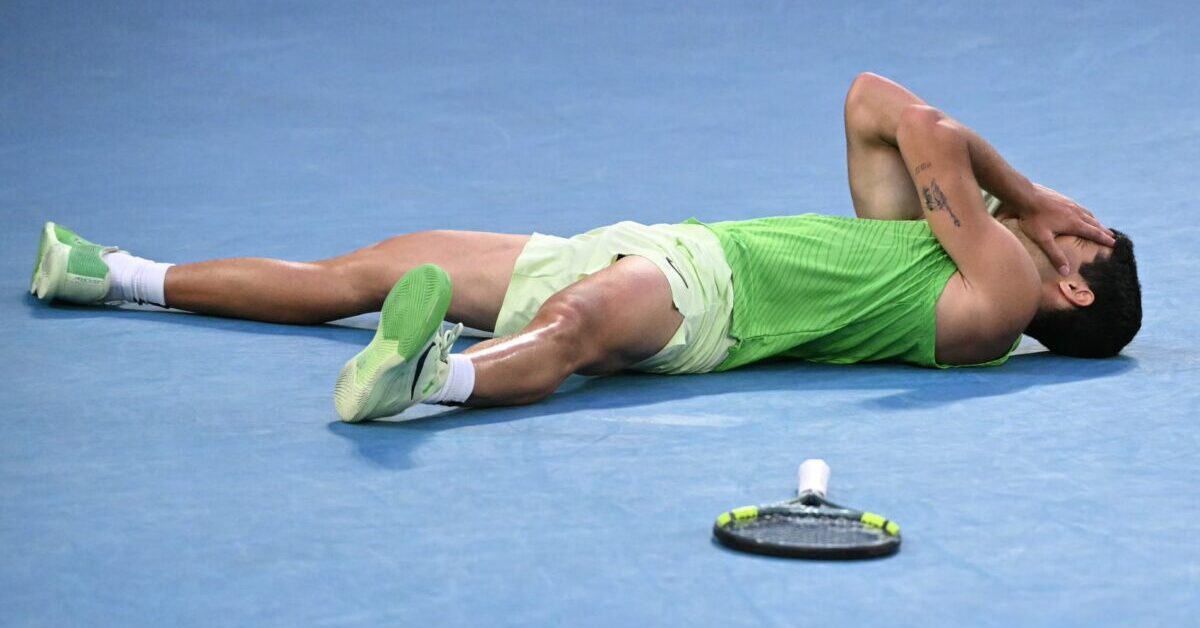
Inside a roaring Rod Laver Arena, World No. 1 Carlos Alcaraz found a way. The 22-year-old fought through an upper right leg scare, late cramps, and a furious Alexander Zverev to win a five-set epic in 5 hours and 27 minutes — the longest semifinal in Australian Open history. The final score: 6-4, 7-6(5), 6-7(3), 6-7(4), 7-5.
It was a night that had everything: world-class shot-making, a momentum swing that felt like a storm, a test of pain and courage, and a heated rules dispute that will be debated long after the trophy is lifted. Alcaraz, top of the PIF ATP Rankings, now sits one victory from becoming the youngest man to complete the Career Grand Slam, a mark held by Rafael Nadal.
Alcaraz vs Zverev: a five-hour 27-minute Melbourne classic
The match began like a sprint and turned into a marathon. Alcaraz struck first with fast feet and fearless swings to take the opening set 6-4. When he edged the second set in a tie-break, he seemed in control at two sets to love. Zverev, the World No. 3 at age 28, refused to fold. He raised his serve, tightened his baseline play, and made Alcaraz work for every point.
By the third set at 4-4, the drama stretched beyond tactics. Alcaraz crouched, grabbed at his upper right quad, and looked in discomfort. He still held serve, then received physio work during the changeover. That moment, and what happened next, changed not only the match but also the mood inside the arena.
- Venue: Rod Laver Arena
- Duration: 5 hours, 27 minutes (longest semifinal in tournament history)
- Score by sets: 6-4, 7-6(5), 6-7(3), 6-7(4), 7-5
- Ages: Alcaraz 22; Zverev 28
- Rankings: Alcaraz No. 1 (PIF ATP), Zverev No. 3
“Five and a half hours, and the kid still had a gear. That’s why he’s No. 1.”
The injury scare and the medical timeout controversy
What happened at that changeover set off a firestorm. Cramps are typically not an injury that can be treated with a medical timeout under the rules. Zverev believed Alcaraz was getting treatment for cramps and exploded in anger toward officials.
He told the supervisor, “It’s unbelievable that he can get treated for cramps. This is b******t.” He also snapped, “You’re protecting these two guys [Alcaraz & Sinner] all the time.” Later, he pressed the chair umpire on the timing rules: “Why are you not starting the clock for 15 seconds?”
From the commentary box, former champion Jim Courier added fuel to the fire: “This is such a travesty. They have totally botched this. That’s why Zverev is melting down right now.” The uproar cast a shadow over a shining tennis night and will invite deeper rule talk from players, coaches, and officials.
The key fact remains: Alcaraz held serve at 4-4 despite pain, then was attended to at the changeover. The action moved on, but the argument did not. The match turned tense, the crowd divided, and both players were forced to deal with more than just the ball.
“If cramps get treatment, what stops any player from calling one at 4-4?”
Zverev’s surge, Alcaraz’s answer
To his credit, Zverev didn’t just complain. He played bold, heavy tennis. He snatched the third set in a tie-break. He repeated the trick in the fourth. At two sets all, the German had the momentum and the swagger. Alcaraz, dealing with the body and the moment, was now in a fight he didn’t plan to have.
The fifth set was a tug-of-war. Zverev pushed ahead, and Alcaraz fell behind 3-5. This is where great players live: in the tightest, toughest passages. Alcaraz found first serves, stepped inside the baseline, and trusted his forehand again. Point by point, he reeled Zverev back in. The end came quick: 7-5 to the World No. 1, after five hours and 27 minutes of heart and nerve.
It was not just about shot choices. It was about belief. The young Spaniard did not let the cramps, the noise, or the pressure break him. Zverev played at a level that beats almost anyone. On this night, it still wasn’t enough.
“Zverev played the better middle. Alcaraz owned the end. That’s the difference at the top.”
Australian Open implications: history on the line
With this win, Alcaraz moves into his first Australian Open final. He is now one match from the Career Grand Slam at just 22 years old. If he wins the title on Sunday, he would be the youngest man to finish the set of majors. That is a huge carrot, and a very real piece of history.
Waiting for him is either World No. 2 Jannik Sinner, the two-time defending Australian Open champion, or Novak Djokovic, the 10-time king of Melbourne Park. Either opponent brings a massive test. Against Sinner, it’s speed versus speed, youth versus youth. Against Djokovic, it’s a challenge against the most successful player this event has ever seen.
For Zverev, this one will sting. He emptied the tank, fought back from two sets down, and stood on the brink in the fifth set. But the margins at this level are razor thin. One loose return, one brave forehand, one swing of belief—that is often the whole story.
What the controversy means for tennis
The dispute over the medical timeout will not fade quickly. The rule around cramps and on-court treatment is meant to be clear, but the gray area appears when the physio is called, players cramp late, and the match context becomes intense. On this night, the process and communication left players and fans confused and frustrated.
When a former champion like Courier says, “They have totally botched this,” the sport should listen. At a minimum, the tour and the Grand Slams will face new questions: How do you keep player care safe and fair? How do you protect the flow of play and avoid tactical abuse? And how do you keep trust between players and officials when the stakes are sky high?
None of that should take away from the courage both men showed. But the sport can celebrate the classic and still want clearer rules. Big matches deserve big clarity.
Bottom line: a classic with a cost
This was elite tennis. It was also messy in moments. Alcaraz’s win adds another layer to his fast-growing legend: grit under pain, patience under fire, and a finishing kick that champions have. Zverev’s level in sets three and four was outstanding. His anger was real, and many fans felt the same.
Now the tournament goes forward with a blockbuster final on deck. Alcaraz will try to make history. His body will be watched closely. His spirit, as always, seems ready. And after the longest semifinal in Australian Open history, the only safe bet is this: he will not stop swinging.