
Key Takeaways:
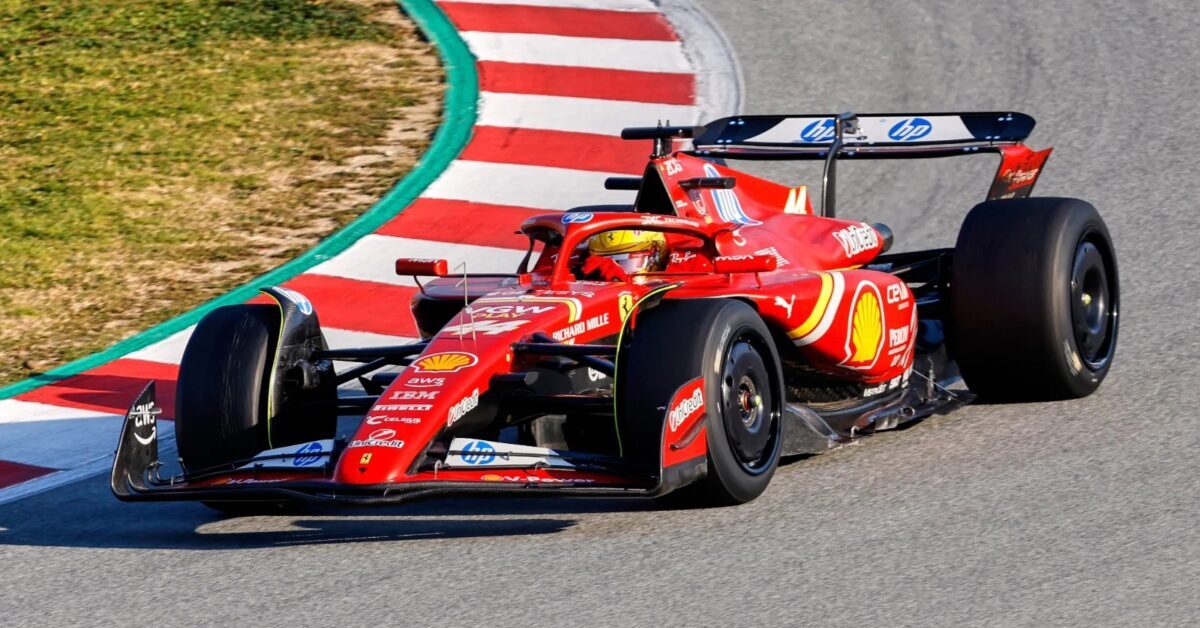
- Lewis Hamilton set the fastest time at Barcelona with a 1:16.348s for Ferrari on Day 5.
- Mercedes ran a class-leading 502 laps across three days; George Russell logged 265 laps and a 1:16.445.
- Ten of 11 teams ran; Williams skipped to protect Bahrain spares and upgrades.
- Red Bull teams completed 623 laps with the new DM01 power unit, focusing on reliability.
- Audi (240–243 laps) and Cadillac (164 laps) faced normal new-team teething, but kept running.
- Lap times were secondary; this extra shakedown was all about mileage under sweeping 2026 rules.
Five days. Hundreds of laps. One clear headline. Formula 1’s 2026 era crept from CAD screens to the race track as 10 of the 11 teams ran their brand-new cars and power units behind closed doors at the Circuit de Barcelona-Catalunya. The goal was simple: bank miles, find gremlins, and learn fast before the two official Bahrain tests.
And the driver who set the benchmark? Lewis Hamilton. On the final day (January 31, 2026), the new Ferrari signing clocked a 1:16.348s to top the unofficial charts. Right behind him on the combined times was George Russell with a 1:16.445s set on Day 4, while Lando Norris stacked third with a 1:16.594s on Day 5. One team, however, chose not to turn a wheel in Spain: Williams, who prioritized spares and upgrades for Bahrain and the first flyaways.
The lap times are not the story of a shakedown. But they do give a hint of who hit the ground running—and who still has homework.
Ferrari pace grabs the headline
Hamilton’s 1:16.348s came late, but it set the tone for a Ferrari program that looked both tidy and fast. Charles Leclerc topped the final morning with a 1:16.653 and punched out 78 laps, underlining a strong day-five push. Over the week, Ferrari ran 440 laps and, when combined with sister team mileage, Ferrari power units approached the 1,000-lap mark. That is the kind of early reliability teams crave under new rules.
Are lap times meaningful at a shakedown? Only a little. But speed plus mileage is a happy mix. Ferrari had both.
“Ferrari are quick and tidy—are we set for a red dawn in 2026?”
Mercedes: mileage kings, quietly confident
No team did more laps than Mercedes. Across three days they totaled 502 tours of Barcelona, with George Russell alone logging 265. Russell also set the second-best time of the week, a 1:16.445 on Day 4. The Silver Arrows even wrapped early on Day 4, alongside Racing Bulls, a sign they got what they needed without unnecessary risk.
For a shakedown, that is gold. In 2026, reliability is the first performance upgrade.
“502 laps. That’s the stat that matters most for Mercedes.”
McLaren’s solid start and a morning marker
McLaren stacked up 291 laps and earned praise from CTO Tim Goss: “It’s been really, really successful… to get out there and just run successfully, both ourselves and the sister team as well, has been really impressive.” Norris added a touch of speed polish with a 1:16.594 late in the running.
Elsewhere, Haas prospect Oliver Bearman—set to do heavy lifting for data—rattled off a test-high 106 laps in the Day 5 morning alone. That’s a huge chunk of learning for the team and suppliers.
Red Bull’s DM01 banks laps, Racing Bulls finish early
Across both Red Bull squads, the new DM01 power unit tallied 623 laps. That is a strong first check on reliability for a brand-new engine package. Racing Bulls, like Mercedes, stopped early on Day 4, suggesting they got through the program cleanly.
The timesheets were never the target here; making the engine run cleanly across conditions was. On that front, the numbers read well.
Williams’ strategic no-show
Only one team stayed home: Williams. Team principal James Vowles explained the logic in blunt terms. “It’s incredibly painful… We could have made Barcelona testing, but in doing so, I would have to turn upside down the impact on spares components and updates across Bahrain, Melbourne and beyond. I stand by our decision.”
Williams runs a Mercedes power unit and gearbox, so much of the core learning still flows their way. The trade-off: arrive stronger in Bahrain with more parts and updates in hand.
“Skipping Barcelona only matters if Bahrain goes wrong. High-risk, high-reward call.”
New teams, new lessons: Audi and Cadillac
Audi and Cadillac stepped into the deep end and did what first-timers must: keep circulating, fix faults, and learn. Audi completed 240–243 laps, with Gabriel Bortoleto covering 94 and Nico Hülkenberg just under 100. As Bortoleto put it, “The shakedown is literally just to put the car on track and test if everything is running. Obviously we expect all these issues… that’s what the shakedown is for.”
Cadillac, with Valtteri Bottas leading mileage at 87 laps, banked 164 laps. Bottas summed up the mood: “It’s great, but it is the problem-solving phase of the team… really a milestone.” Both programs had bumps, but both kept the wheels turning. That is the right early signal.
Aston Martin’s quiet week
Aston Martin had a tougher run at it: only 65 laps in total. Lance Stroll logged just 4 laps, while Fernando Alonso’s tally sat between 49 and 61 laps across the days. It is not panic time—this was a shakedown—but the team will want a smooth reset in Bahrain.
The context: mileage over magic, with a nod to history
This Barcelona run was a bonus test because the 2026 rules are complex and fresh. Teams needed extra time to make sure cars, software, and power units talked to each other before the official group sessions. The opening day alone produced around five times more laps than 2014’s first day of a new era (back then, teams managed just 93 laps combined). That is progress.
Still, the times are not apples to apples. Fuel loads, engine modes, track conditions, and test plans vary wildly. What matters is whether cars ran, how often they ran, and what issues showed up.
Winners and the watchlist
- Ferrari: quick and busy. Hamilton’s 1:16.348 and Leclerc’s 1:16.653 hint at a car that responds well already.
- Mercedes: the mileage benchmark with 502 laps and Russell’s 1:16.445. Quietly effective.
- Red Bull/DM01: 623 laps—exactly the reliability sign you want with a new power unit.
- McLaren: 291 laps and a top-three time from Norris. No fuss, lots of learning.
- Audi and Cadillac: normal teething, steady laps, the right mindset.
- Aston Martin: low mileage to investigate, but time remains before Bahrain.
Notable numbers from Day 5
- Hamilton fastest overall: 1:16.348s (Ferrari)
- Leclerc fastest in the morning: 1:16.653s and 78 laps (Ferrari)
- Norris third overall: 1:16.594s (McLaren)
- Bearman most laps in a morning: 106 laps (Haas)
What happens next?
Now the focus shifts to the two Bahrain tests. Set-ups will get sharper, parts will appear, and we will finally see cars run in similar conditions. Barcelona gave teams a head start on reliability. Bahrain will start to reveal real form.
For now, the scoreboard reads like this: Ferrari showed speed, Mercedes showed stamina, Red Bull’s DM01 showed promise, and Williams took a brave strategic bet. The lap times will be forgotten, but the miles will pay interest all year.