
Key Takeaways(TL;DR):
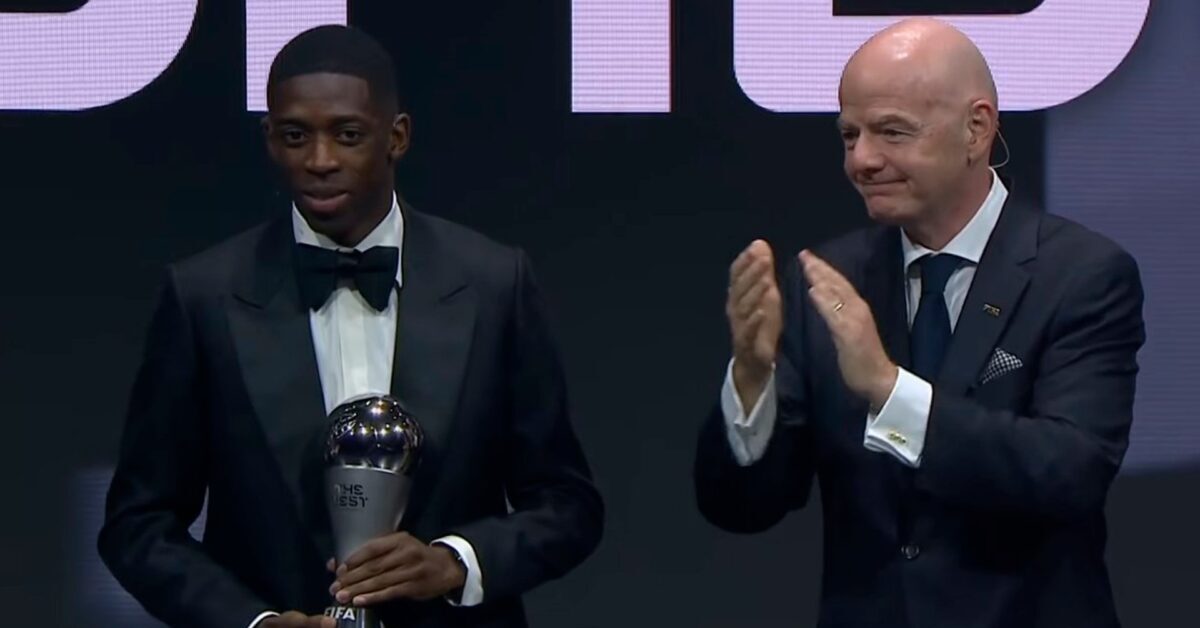
- Ousmane Dembélé wins the FIFA The Best Men’s Player 2025 award in Doha after a stunning 2024/25 season with PSG.
- The French forward adds FIFA The Best to his 2025 Ballon d’Or, completing a rare individual double in the same year.
- Dembélé drove PSG to their first-ever UEFA Champions League title plus Ligue 1, Coupe de France, Trophée des Champions and UEFA Super Cup.
- Across all competitions, he posted around 35‑37 goals and 15‑16 assists, with big numbers in both Ligue 1 and the Champions League.
- PSG dominated the awards season, placing several players in the Ballon d’Or top 10 and in the FIFA The Best shortlist.
- Dembélé calls winning the Ballon d’Or the “Holy Grail” and credits his teammates for lifting their level to chase every trophy.
Ousmane Dembélé has reached the top of world football, and he has done it wearing Paris Saint-Germain colours.
In Doha, Qatar, the French forward was named FIFA The Best Men’s Player 2025, closing the circle on a historic year in which he had already lifted the 2025 Ballon d’Or. The numbers, the trophies and the story behind them leave little room for doubt: this was the season where Dembélé finally put it all together.
Dembélé, FIFA The Best 2025: the last crown on a golden year
The FIFA The Best Awards 2025 ceremony in Doha delivered what many expected but still wanted to see confirmed: Dembélé taking home the men’s award ahead of a star-studded field that included teenage sensation Lamine Yamal, Kylian Mbappé and several of his own PSG teammates.
ESPN’s live coverage captured the moment: “FIFA Best Awards 2025 LIVE! Latest updates as Ousmane Dembélé takes the men’s award.” For a player whose career has swung between flashes of genius and long spells of injury and doubt, the image of him walking up on stage in Doha felt like the final chapter of a long redemption arc.
Importantly, this was not a one-off flash. The FIFA The Best crown arrives just a few months after Dembélé lifted the Ballon d’Or in September, also for his work in the 2024/25 season. Two of football’s biggest individual awards, in the same year, for the same campaign. That is a level of dominance usually reserved for the very top tier: the Messis and Ronaldos of recent generations.
“This is the year Dembélé stopped being a talent and became the standard.”
From fragile promise to PSG superstar
To understand the weight of this award, you have to rewind. Dembélé has always been known for his pace, his dribbling and his rare ability to use both feet almost equally. But he was also known for injuries, inconsistency and the feeling that he might never quite reach his ceiling.
At PSG in 2024/25, that story changed. Under coach Luis Enrique, Dembélé shifted into a more central role as a forward or striker and became the clear attacking leader of a team that finally clicked on the biggest stage.
The numbers tell you why the awards followed:
- Across all competitions, he posted around 35‑37 goals and 15‑16 assists.
- In Ligue 1, he scored about 21 goals and delivered 8 assists.
- In the UEFA Champions League, he added around 8 goals and 6 assists, stepping up when it mattered most.
Different outlets report slightly different totals – one Instagram post pushed “53 games, 35 goals, 16 assists” while UEFA and others list close versions such as 37 goals and 15 assists. But all agree on the main point: Dembélé was decisive in almost every competition PSG entered.
Champions League glory and a clean sweep of trophies
What really sealed both the Ballon d’Or and FIFA The Best, though, was not just the volume of goals and assists. It was the list of trophies and the way Dembélé sat at the centre of all of them.
PSG in 2024/25 were a machine. With Dembélé leading the attack, they captured:
- Their first-ever UEFA Champions League title
- Ligue 1
- Coupe de France
- Trophée des Champions
- UEFA Super Cup
For PSG, the biggest emotional breakthrough was of course the Champions League. After years of frustration and near-misses, the club finally climbed the mountain. Dembélé’s influence, especially in Europe, turned him from a support act into the main star.
That is why, when voting time came around for both France Football and FIFA, it was hard to argue against him. He was not just a top scorer on a good team; he was the face of a project that had finally delivered on its promise.
“PSG didn’t just win the Champions League, they built a Ballon d’Or season around Dembélé.”
Ballon d’Or first, FIFA The Best next: a rare double
The first big sign that this would be Dembélé’s year came in September, when he was handed the 2025 Ballon d’Or by UEFA and France Football after that incredible 2024/25 campaign. On stage, his words were simple and honest.
“C’est grâce à vous tout ça. Ça a été exceptionnel toute une année… on a élevé notre niveau pour aller chercher tous ces trophées collectifs.“
In English: this is all thanks to you; it has been an amazing year; we raised our level to go and get all these team trophies. The message was clear. For Dembélé, the personal glory meant little without the team success that underpinned it.
He added another line that summed up what the Ballon d’Or still means to players:
“Winning a Ballon d’Or when you’re a football player is obviously the Holy Grail individually… Just the object, the ball, it’s exceptional.”
Many players have dreamed of holding that golden ball and never come close. For Dembélé, it became a reality because PSG’s season matched his own growth. When FIFA’s The Best voting later reflected the same story, it confirmed that this was not just a France-based or Europe-based opinion. The global game had decided: Dembélé was the standout.
PSG’s award-season takeover
Dembélé’s rise did not happen in a vacuum. PSG as a whole dominated the awards landscape in 2025. The Ballon d’Or top 10 read like a PSG squad list:
- 1st – Ousmane Dembélé
- 3rd – Vitinha (midfielder, key in linking defence and attack)
- 6th – Achraf Hakimi (attacking full-back, constant outlet on the right)
- 9th – Gianluigi Donnarumma (goalkeeper, anchor at the back)
- 10th – Nuno Mendes (dynamic left-back, big two-way presence)
That kind of spread shows just how strong PSG were across the pitch. It also explains why Dembélé was so keen to share the credit. Surrounded by high-level teammates, he found a platform where his best version could shine every week.
The same theme carried into the FIFA The Best shortlist. Dembélé was joined among the nominees by young Barcelona and Spain star Lamine Yamal, former PSG icon Kylian Mbappé and several other Paris players. The ceremony itself took place just before PSG’s Intercontinental Cup clash with Flamengo, a reminder that even as the awards rolled in, the games kept coming.
“PSG owning the Ballon d’Or list and The Best shortlist feels like the power shift we’ve been waiting for.”
Beating Yamal and the new wave of stars
One of the most interesting elements of this award is whom Dembélé beat to get it. Lamine Yamal, who finished as Ballon d’Or runner-up, is seen by many as the future of football: a teenager already shaping games for club and country.
To outshine Yamal in a year when the youngster made so many headlines says a lot about the level Dembélé reached. There were also comparisons to Mbappé, who has long been seen as the next face of the sport. In 2024/25, though, it was Dembélé pulling PSG’s strings in attack and making the defining plays in their biggest matches.
In that sense, the award is not just about what Dembélé has done, but about what it signals. For a long time, he was grouped with the “might be” players. Now, in a football world looking for a new set of global stars after the Messi-Ronaldo era, he has placed himself firmly in the “is” category.
Why this FIFA The Best matters beyond the trophy
On the surface, FIFA The Best is an individual prize. A shiny statue, a photo on stage, a place in the history books. But for Dembélé and PSG, it stands for more.
For the player, it is the final answer to years of questions about consistency, maturity and end product. His stats, his titles and now his awards show that he can carry the weight of being the main man for a superclub.
For PSG, it is proof that their project can do more than dominate the local league. Producing a FIFA The Best and Ballon d’Or winner, on the back of a Champions League win, changes how the club is viewed by players, fans and rivals.
And for the wider game, it is a sign that the spotlight is now wider than just one or two legends. Dembélé’s season sits alongside the rise of Yamal and the continued excellence of players like Mbappé as part of a new, more open era at the top of world football.
What comes next for Dembélé and PSG?
The challenge with any peak season is what follows. Winning everything once is hard; defending it is even harder. With FIFA The Best 2025 and the Ballon d’Or already in his cabinet, Dembélé will now be judged by a different standard.
Can he keep this level of output? Can PSG stay at the top of Europe with everyone aiming to knock them off? How will rising stars like Yamal, and familiar rivals like Mbappé, respond?
What we do know is that December 16, 2025 in Doha will go down as the night Ousmane Dembélé’s status was made official. Not just a brilliant winger. Not just a player with potential. But FIFA The Best Men’s Player, the man who defined a season and finally turned promise into proof.
The rest of his story, and PSG’s, starts now.