
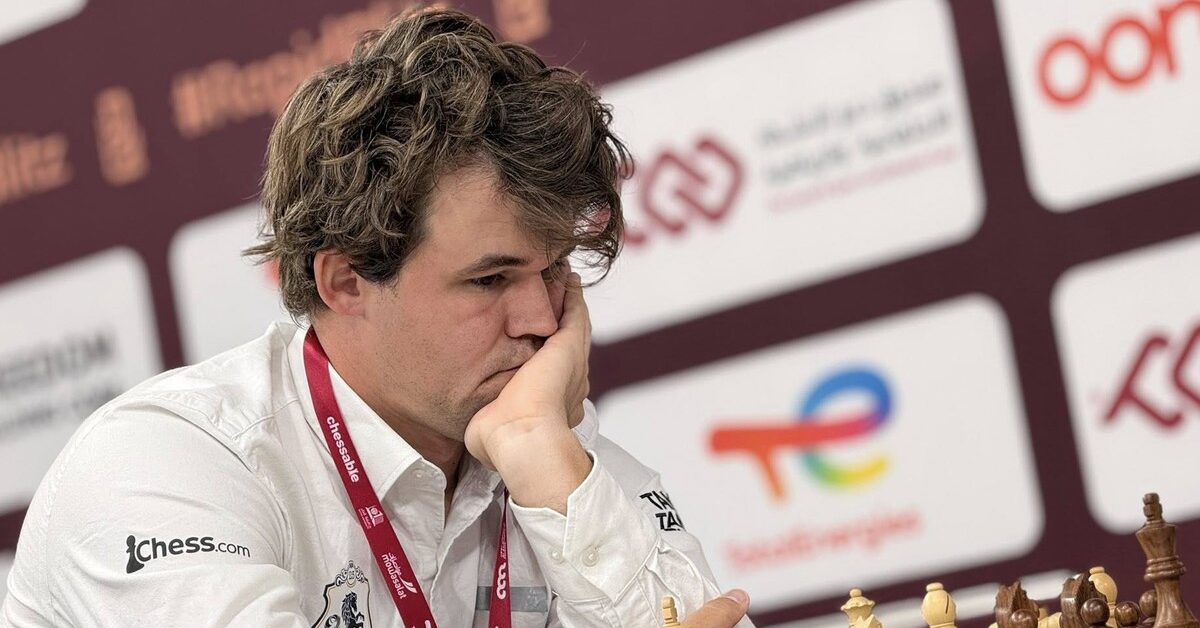
Key Takeaways(TL;DR):
- Magnus Carlsen won the 2025 FIDE World Rapid Chess Championship in Qatar with 10.5/13.
- It is his record sixth World Rapid title and his 19th World Championship crown overall.
- A Round 12 victory gave him a full-point lead; he then drew the final round with White against Anish Giri.
- Carlsen said this was his highest score in a 13-round event.
- He overcame a shaky start and a 10-minute delay before the first game by staying calm and focused.
- Key games turned on positional pressure, including a weakness on d4; the penultimate round featured a Ruy Lopez, Breyer Variation.
Magnus Carlsen did it again. In Qatar, the Norwegian star finished a fierce 13-round sprint with a calm draw to secure the 2025 FIDE World Rapid Chess Championship. His final tally—10.5/13—put him a clear point ahead of the pack and handed him a record sixth World Rapid title. For Carlsen, who called it his highest score in a 13-round event, this was not just another win. It was a fresh mark on a record book he keeps rewriting.
He closed the show by steering White to a controlled draw against Anish Giri in the last round. But the real punch landed one round earlier. A win in Round 12 gave Carlsen the full-point cushion he needed, and from there he never looked back. This title also takes his total to 19 World Championship crowns across formats. That number speaks to longevity, but the way he got there in Qatar speaks to form.
Carlsen’s record keeps growing
Six World Rapid titles is a line few could imagine when rapid chess became a marquee stage for big names. Carlsen has made it the arena where he looks most at home: fast, sharp, and unforgiving. His 10.5/13 here is not only a winning score; it is a personal best over 13 rounds, by his own words. In a field where one slip can end your run, that level of consistency is gold.
What sets this win apart is how it blends old Carlsen with new urgency. The patience, the squeeze, the endgame control—they were all there. But the killer moment came on time, and came clean. Once he got ahead, he managed risk like a seasoned champion. A one-point lead late in rapid is massive, and Carlsen handled it like a player who has been here many times before.
“Sixth rapid crown and still hungry—who stops him now?”
Round 12: the breaking point
The tournament turned on Round 12. Carlsen won, stretched the gap to a full point, and put real pressure on everyone else. The way he did it matters. He leaned on positional targets—especially a weak d4 square—until the position cracked. In rapid chess, you often don’t win with flashy tactics; you win by making the simple moves that build up. That is what Carlsen did.
The penultimate round also featured a Ruy Lopez, Breyer Variation, a deep and patient opening that fits his style. It’s a system that can look quiet, but it hides energy. In fast time controls, that energy shows up as space, better pieces, and small squeezes that add up. Carlsen’s play here showed both trust in his preparation and confidence in his judgment.
He explained after the win that some opponents looked to steer him toward short draws in positions where he might be slightly better. “He kind of played his strategy quite well … even in a somewhat better position he essentially offered a draw which I didn’t take,” Carlsen said. That choice—to decline the easy exit—defined his week.
“Round 12 wasn’t just a win; it broke the chase pack’s will.”
Calm under fire: a shaky start and a delay
This run did not begin smoothly. “I was just not feeling good at all… sitting down for the first game,” Carlsen said. A 10-minute delay before the opening round forced him to reset on the spot. “I was really trying to calm down.” Those are not the words of a player cruising. They’re the words of a champion who knows how to manage nerves.
From there, his plan was clear: keep the pieces active, take the initiative when it is there, and avoid panic when it is not. He also noted this was his best score in a 13-round event. That tells you he found rhythm after the slow start and then never lost it.
Final move: control against Anish Giri
When the moment came to seal the title, Carlsen did what pros do. With White against Anish Giri in the final round, he chose control over risk. A measured draw was all he needed, and he took it without fuss. It’s not the flashiest finish, but it is how titles are often won in elite rapid. You land the blow early, then you make sure the door is shut.
Giri, a top-class grandmaster and frequent rival, has the type of style that makes you earn every half-point. That Carlsen held the line with clarity says a lot about where his head was on the last day: steady, focused, and respectful of the scoreboard.
“Is 10.5/13 the new bar for greatness in rapid?”
Why it mattered: pressure play and small edges
This event reminded everyone what makes Carlsen so hard to beat at speed. He loves small edges. A weak square on d4. A slightly better endgame. A smoother pawn structure. In rapid, these details show up fast and they stick. If you miss one defensive move, he is already there with the next question.
When an opponent floated an early draw idea, Carlsen pushed on because the position still held juice. That is a risk, but it is measured risk—the kind that wins big events. He sensed that the field would blink first if he kept the game alive. Round 12 proved him right.
The legacy column: 19 and counting
With this title, Carlsen reaches 19 World Championship crowns across formats. The number is huge, but the story is simple: he keeps showing up and he keeps winning. Rapid chess is a different beast from classical, yet his edge shows in both. In Qatar, he paired patience with precision, and he was brave at the exact moments that required it.
He also showed the value of tournament feel. Even when the first game felt off and the start was delayed, he adjusted. He stayed patient, declined short-term comfort, and trusted his read of the board. That is not just skill; it is leadership over his own game.
What comes next
For now, the headline is clear: Carlsen’s grip on rapid chess is as strong as ever. The record sixth crown, the clean draw to finish, the Round 12 surge, and a personal-best 13-round score—Qatar gave him a complete win. For the rest of the field, the message is just as clear. If you want this title, you have to go through him. And that has never been easy.
Sometimes greatness looks like a knockout. Other times it looks like a steady hand that never shakes. In Qatar, it looked like both.