
Key Takeaways:
- Carlos Alcaraz beat Alex de Minaur 7-5, 6-2, 6-1 in the Australian Open 2026 quarterfinal at Rod Laver Arena.
- Match time was 2 hours 15 minutes; Alcaraz made his first Australian Open semifinal and has not dropped a set all tournament.
- Alcaraz improved to 6-0 head-to-head vs. De Minaur, having dropped only two sets across those meetings.
- First set swing: Alcaraz led 3-0; De Minaur surged to 5-5 and served for it, but Alcaraz broke back and closed 7-5.
- Before the quarters, De Minaur had dropped only one set and had beaten Frances Tiafoe and Alexander Bublik in straight sets.
- Next: Alcaraz faces Alexander Zverev; a title would complete his Career Grand Slam as the youngest man to do it.
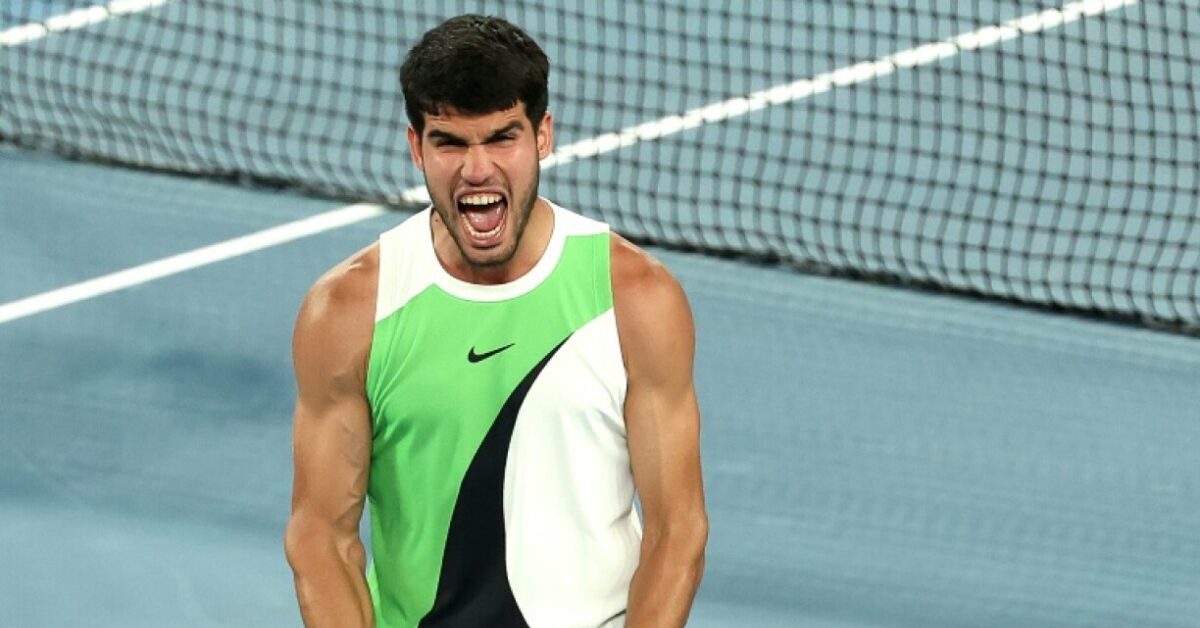
Carlos Alcaraz arrived at Rod Laver Arena as the World No. 1 and left with something new in his pocket: a first Australian Open semifinal. The top seed beat Australia’s Alex de Minaur 7-5, 6-2, 6-1 in two hours and 15 minutes, a performance that mixed early fire with calm control when it mattered most. He has not dropped a set in Melbourne this year, and he will meet Alexander Zverev next in the final four.
For De Minaur, Australia’s No. 1 and the last home hope in the men’s draw, it was a tough end to a strong run. He had looked sharp all fortnight, but his search for a first win over Alcaraz continues. The head-to-head now sits at 0-6.
Alcaraz’s reset turns a tight first set
The match opened at a sprint. Alcaraz raced to 3-0, cracking forehands and taking time away. Then De Minaur dug in, stretching rallies, rushing the Spaniard, and turning the set on its head. Soon it was 5-5, with the Australian breaking to serve for the lead before Alcaraz snatched the momentum back. The top seed steadied, broke back, and closed the set 7-5.
Alcaraz later explained the shift. “I started the match really well, hitting the ball really well,” he said. “But Alex puts you in a rush all the time… From 3-0 until 4-3, 4-4, I wanted everything in a rush, so I took a moment, took a break mentally. I was more patient until the end of the match.” That pause—more mental than tactical—set the tone for the rest of the night.
“This is what a World No. 1 looks like—no panic, just problem-solving.”
De Minaur’s effort, Alcaraz’s answer
De Minaur came in with confidence and a clear plan: be bold, step inside the baseline, and hit bigger. He said as much afterward. “In terms of mentality or the way I committed to hitting the ball today, it’s what I set out to do. I just can’t really execute it. I didn’t really execute it for the whole match.”
It wasn’t for lack of effort. “I’m probably hitting the ball bigger than I’ve hit previously in these types of matches, but I’m still not able to kind of hit through him,” he admitted. Against Alcaraz, even good shots came back with interest. When the first set slipped away, the gap only grew. The second and third sets ran one way—6-2, 6-1—as Alcaraz tightened up his patterns and took the air out of rallies.
De Minaur had been one of the form players of the fortnight. He dropped just one set in his first four matches and took out both Frances Tiafoe and Alexander Bublik in straight sets. But the match-up remains a mountain. With this defeat, he is 0-6 against Alcaraz, with only two sets taken across those meetings.
“De Minaur is better than ever, and it still isn’t enough against Alcaraz.”
Numbers that tell the story
Sometimes the stats are simple and loud:
- Scoreline: 7-5, 6-2, 6-1 to Alcaraz.
- Duration: 2 hours, 15 minutes on Rod Laver Arena.
- Head-to-head: Alcaraz leads De Minaur 6-0, with only two sets lost in those matches.
- Melbourne form: Alcaraz has not lost a set through five matches at the Australian Open 2026.
- De Minaur’s path: just one set dropped before the quarters; straight-sets wins over Frances Tiafoe and Alexander Bublik.
Beyond the numbers, the key edge was composure. Alcaraz’s ability to slow down in the chaos—especially after De Minaur’s surge in the first set—let him flip the pressure back onto the Australian. From there, the top seed managed the scoreboard, shortened points when needed, and closed like a veteran.
De Minaur’s honest reflection
There was frustration in De Minaur’s voice, but also clarity. “I’m playing out of my comfort zone and at times out of my skin,” he said. “You try to do the right things, you try to keep on improving, but when the results don’t come or the scoreline doesn’t reflect those improvements, then of course you feel quite deflated.”
That honesty will sting tonight. It may also serve him well going forward. He has lifted his level, and the crowd at Rod Laver Arena felt it, especially in the first set. But against the world’s best, the bar is even higher, and tiny gaps become big.
“Zverev next. If Carlos serves like this, pencil him into Sunday.”
What it means: Zverev next, history in sight
Alcaraz moves on to face Alexander Zverev in the semifinals. Zverev reached the last four by defeating Learner Tien and has been steady all tournament. The matchup brings power on power and a battle of first strikes. It will test Alcaraz’s serve and return patterns again, and it will test Zverev’s resolve under heat.
There is also a larger story in play. If Alcaraz goes on to lift the trophy in Melbourne, he will complete the Career Grand Slam—and do it as the youngest man in history. That would beat Rafael Nadal’s mark (set at age 24 in 2010). For a player who has already grabbed so much so fast, it is a huge prize, and it is now only two wins away.
The tournament, running from January 18 to February 1, still has its defending champion in the mix—Jannik Sinner. But the World No. 1 has put down a marker. Five matches, zero sets dropped, and a growing sense that his ceiling on hard courts keeps rising.
Rod Laver Arena felt the surge
Big-night tennis in Melbourne carries a special charge, and the first set delivered it. The crowd roared for De Minaur’s fight and gasped as Alcaraz found answers from both wings. By the end, the energy turned into a standing nod for a world-class performance.
De Minaur, Australia’s top-ranked man, was the last home hope in the men’s singles. The dream of a home men’s champion—something not seen since Mark Edmondson in 1976—will wait another year. But if he keeps building on this level, he will be back in this late-week spotlight.
The bottom line
This was a mature win for Carlos Alcaraz. He dealt with a fast start, a mid-set wobble, and a stubborn opponent. He then took control and never loosened his grip. The numbers say dominant. The eye test says calm and clinical.
Next is Zverev and another heavy test. If Alcaraz keeps mixing patience with punch, Melbourne might be where his Career Grand Slam quest reaches the finish line.