
Key Takeaways(TL;DR):
- Lionel Messi’s GOAT India Tour 2025 event in Kolkata was cut short after crowd unrest and pitch invasions at Salt Lake Stadium.
- Fans invaded the pitch, tore goal nets, broke seats and hurled objects inside the 85,000-capacity Salt Lake Stadium.
- Live coverage showed bottles and chairs being thrown, people injured, and police using baton charges and dispersal tactics.
- The event was sold as a Messi spectacle for India, but questions over crowd management and security planning now dominate the story.
- As of the live reports used here, no detailed official statements or confirmed casualty numbers had been released.
- The Kolkata chaos will likely become a key case study in how India handles future mega-celebrity and football events.
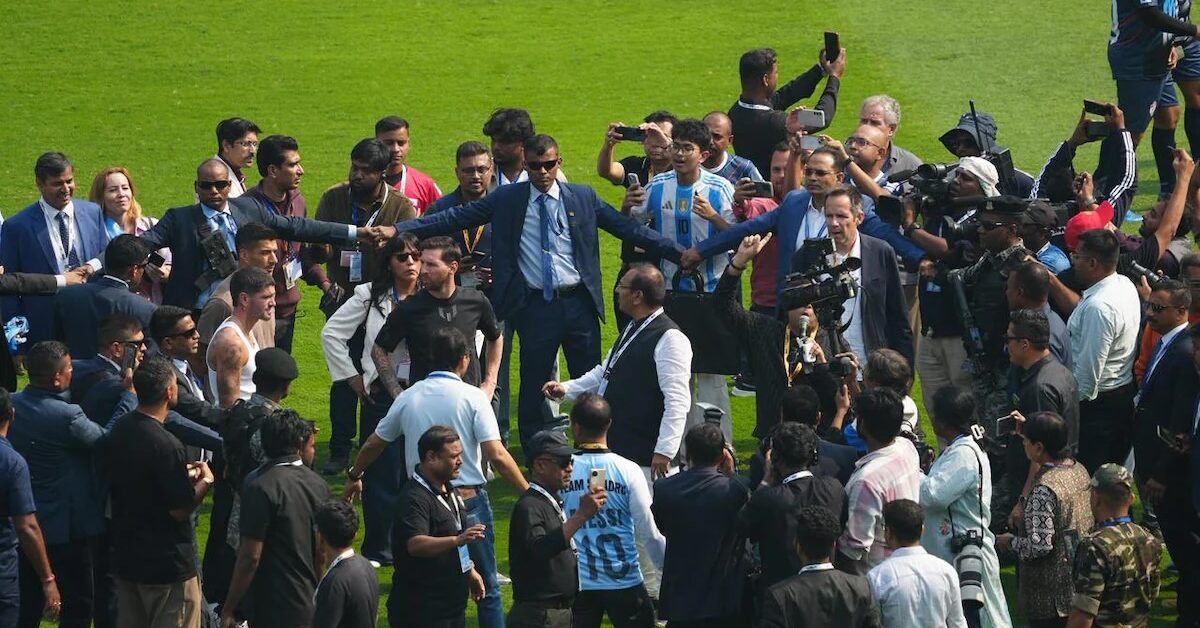
For many fans in India, the chance to see Lionel Messi live is a once-in-a-lifetime dream. On the GOAT India Tour 2025 stop in Kolkata, that dream was meant to come to life inside the iconic Salt Lake Stadium. Instead, it broke apart in a rush of bodies, broken seats and panicked security as the night turned from celebration to chaos.
What should have been a landmark moment for Indian football fans quickly turned into a worrying reminder: when crowd control fails, even the biggest star in the world cannot save the show.
Messi in Kolkata: A dream night that didn’t last
Lionel Messi’s visit to Kolkata was heavily promoted as part of his GOAT India Tour 2025, with huge hype and emotion wrapped around the occasion. The Salt Lake Stadium, officially known as Vivekananda Yuba Bharati Krirangan, is one of India’s largest and most famous football grounds, with a capacity of around 85,000. It has hosted packed international matches, derby clashes and legends of the game.
This time, it was Messi himself walking out on that stage. The build-up had a festival feel. Fans packed into the stands, many wearing Argentina shirts, Messi jerseys and national flags. For some, this was the closest they might ever come to the man many call the greatest of all time.
But according to video and live coverage from News9 Live and other local streams, the calm did not last long. Very quickly, the story was no longer about Messi’s presence. It was about the crowd.
“We waited our whole lives for Messi in Kolkata, and in minutes it turned into something we never wanted to see.”
Pitch invasions and vandalism: how the chaos unfolded
Live footage from the stadium showed scenes that felt more like a riot than a fan meet-and-greet. Fans were seen invading the pitch, climbing over barriers and running across the turf that was supposed to host a grand show.
It did not stop there. Video clips captured people vandalising seats and goal nets, pulling at stadium fixtures and turning what should have been protected match equipment into props and targets. Objects flew through the air. Seats and bottles were reportedly hurled from the stands.
In some frames, supporters were seen trying to grab pieces of the net, a souvenir turned symbol of how quickly order had broken down. In others, groups pushed closer and closer to the field, overwhelming stewards who could not hold the line.
News9 Live, which broadcast from the venue, placed a warning on its livestream: “Viewer discretion advised. Violent scenes broke out at Kolkata’s Salt Lake Stadium during Lionel Messi’s GOAT India Tour 2025 event as fan frenzy spiralled out of control.”
The message matched what the cameras were showing. This was no longer a controlled event. It was a situation spiralling away from organisers.
Police response: bottles, chairs and baton charges
Multiple live streams and local reports from inside the ground painted the same rough picture. Bottles and chairs were thrown. People were injured, though detailed and confirmed numbers were not yet available in the live coverage used here.
With sections of the stadium losing control, the police moved in. Footage showed officers using baton charges and dispersal tactics to push crowds back and clear the pitch. These measures may have been necessary to protect players, staff and other fans, but they also added another layer of fear for those caught in the middle, including families and young children who had come to see Messi, not a clash with law enforcement.
At the time of the live reports, there were no full, formal statements from Kolkata Police, stadium officials or the event organisers explaining the decisions taken, how the plan had been drawn up, or whether there had been clear warnings that control was slipping. Those explanations will matter in the days ahead.
“If we can’t keep one football event safe, how will we ever host a World Cup game or a big final in India?”
Why did it happen? The bigger questions on security and planning
When chaos erupts on a night like this, fans, media and officials all ask the same thing: why? We do not yet have full investigations or official reports, but the live coverage already raises serious doubts about how this event was planned and managed.
For high-profile sports and celebrity events, there are some basic pillars of safety:
- Strict entry control and ticket checks
- Clear separation between stands and pitch
- Enough trained security and stewards
- Fast communication between organisers, police and stadium staff
- Emergency plans for crowd surges or pitch invasions
Judging by what was seen on the ground, at least some of these pillars did not hold. The number of fans, the excitement around Messi, and the emotion of the moment all made this a high-risk event from the start. That is exactly why security and crowd control should have been even tighter than usual.
Instead, we saw fans breaching barriers, running freely onto the pitch, and damaging stadium property. That does not happen if every layer of protection is working properly.
It is easy to blame “passionate fans” and move on. But that ignores the real issue. Passion is predictable. So is the rush to get close to an icon like Messi. Good planning respects that passion and channels it into safe, controlled energy. Poor planning leaves the door open for things to go very wrong, very fast.
Messi’s India story: from joy to concern
For Messi, this was supposed to be another chapter in a global tour that reinforces his bond with fans far beyond Europe and South America. India has long been a country where football love runs deep, even when the national team rarely features on the world stage. Kolkata, in particular, has a strong football culture and a history of hosting huge crowds for the sport.
That is what made this stop so special on paper. The idea of Messi in Salt Lake Stadium carries emotional weight, not just in Kolkata but across India. Yet the scenes that forced his appearance to be cut short may now overshadow the joy of his arrival.
His team and the tour organisers will be asking tough questions behind closed doors: Was enough done to keep him and everyone else safe? Could they have predicted this kind of surge? Will the rest of the GOAT India Tour be changed because of what happened in Kolkata?
“We wanted Kolkata to show the world our love for football; instead the world saw us lose control on our biggest night.”
What this means for Indian football and future mega-events
The Kolkata incident will not stay a local story for long. Any event linked to Lionel Messi travels fast across global media, and video of bottles flying and police baton charges in a packed stadium are the kind of images that raise alarms well beyond India.
For Indian football authorities, stadium owners and local governments, this night must act as a serious warning. India often speaks about its ambition to host bigger tournaments and to bring more international stars to its grounds. That ambition cannot exist without rock-solid safety standards.
Future organisers will be judged by how they respond now:
- Will there be transparent investigations into what went wrong?
- Will stadium infrastructure be checked and upgraded where needed?
- Will security plans for celebrity tours and friendly matches be treated with the same seriousness as major international fixtures?
- Will fan education and communication improve so that people know what is allowed and what is not before they even enter the venue?
Fans, too, have a role. The love for Messi is real, and it is powerful. But when that love crosses into dangerous behaviour — rushing the pitch, throwing objects, damaging seats and nets — it puts everyone at risk, including the hero they came to see.
What we know now — and what we still don’t
Based on the live coverage available so far, certain facts are clear:
- Messi’s appearance at Salt Lake Stadium was cut short because of large-scale crowd unrest.
- Fans invaded the pitch, damaged stadium property, and threw objects such as bottles and chairs.
- People were injured, and police used force, including baton charges, to try to regain control.
- As of that reporting window, detailed official statements from Kolkata Police, stadium officials, tour organisers or Messi’s camp had not yet been shared in full.
What remains unknown, and will be crucial in the coming days, includes:
- Exact injury counts and the condition of those hurt
- The number of arrests, if any, and the specific charges
- Whether organisers or security agencies will face formal action
- How the rest of the GOAT India Tour 2025 schedule might be changed
Until those answers arrive, the Kolkata night remains a half-told story: a huge dream, an unfinished event, and a set of images that will sit uncomfortably next to the joy that Messi usually brings wherever he goes.
From lesson to turning point?
The scenes at Salt Lake Stadium should not define Indian football or Kolkata’s love for the game forever. But they may define what happens next. If this becomes a catalyst for better safety standards, smarter planning and more respect for both fans and players, then some good can still come from a deeply disappointing night.
For now, though, the picture is stark. On a night built to honour the GOAT, the game lost. The hope for everyone who loves football in India is simple: that the next time Messi or any global star walks out in front of 85,000 people here, the only things that make headlines are the cheers, the skills and the memories — not bottles, batons and broken seats.